Dev C++ Ouput Has Io
The C++ classes ifstream and ofstream are subclasses of istream and ostream designed to perform stream input and output to disk files. You can use the same extractors and inserters on ifstream and ofstream objects that you’ve been using on cin and cout.
File I/O in C programming with examples: Learn how to create, open, read, write and close a file in C programming language with examples. C is able to input and output the built-in data types using the stream extraction operator and the stream insertion operator.
The ifstream is actually an instantiation of the template class basic_ifstream<T> with T set to char. The basic_ifstream<T> template class is instantiated with other types as well to provide different types of input classes. For example, the wide stream file class wifstream is based on the same basic_ifstream<T> with T set to wchar_t. The ofstream is the same as basic_ofstream<char>.
The classes ifstream and ofstream provide constructors used to open a file for input and output, respectively:
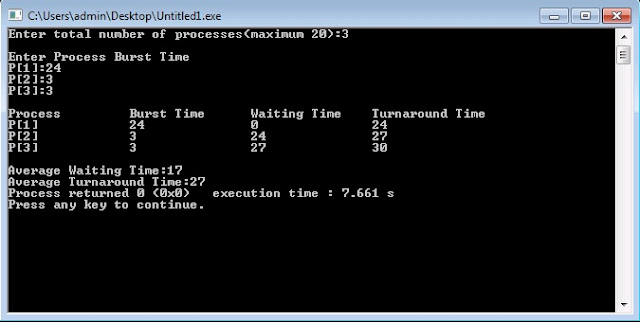%2BScheduling%2BAlgorithm.jpg "Dev C++ Ouput Has Io")
The first argument is a pointer to the name of the file to open. The second argument specifies the mode. The type openmode is an integer type defined in ios_base. Also defined within ios_base are the possible values for mode listed in this table.
- (since C20) The manipulators that are invoked with arguments (e.g. Std:: cout operator which perform the requested manipulation.
- On Windows, the floating point number has output of 1.#INF for positive infinity and -1.#INF for negative infinity. The floating point indeterminate number is -1.#IND. But there's no similar representation of -1.#IO. The most probable reason is, you are outputting numbers with a fixed 3 digits of fraction part.
- Fast, offline, and free documentation browser for developers. Search 100+ docs in one web app including HTML, CSS, JavaScript, PHP, Ruby, Python, Go, C, C, and many.
- Manipulators are helper functions that make it possible to control input/output streams using operator. The manipulators that are invoked without arguments (e.g. Std:: cout std:: hex;) are implemented as functions that take a reference to a stream as their only argument.
These are bit fields that the programmer bitwise ORs together. The default mode for ifstream is to open the file for input with the pointer set to the beginning of the file (that’s logical enough).
| Flag | Meaning |
|---|---|
| ios_base::app | Seek to end-of-file before each write. |
| ios_base::ate | Seek to end-of-file immediately after opening the file, if it exists. |
| ios_base::binary | Open file in binary mode (alternative is text mode). |
| ios_base::in | Open file for input (implied for istream). |
| ios_base::out | Open file for output (implied for ostream). |
| ios_base::trunc | Truncate file, if it exists (default for ostream). |
The default for ofstream is to open for output and to truncate the file if it exists already. The alternative to truncate is ios_base::app, which means append new output onto the end of the file if it exists already. Both options create a file if it doesn’t already exist.
For example, the following StreamOutput program opens the file MyName.txt and then writes some important and absolutely true information to that file:
The destructor for the file stream classes automatically close the associated file. In this simple example, the MyName.txt file was closed when the my object went out of scope upon returning from main(). Global objects are closed as part of program termination.
- C Programming Tutorial
- C Programming useful Resources
- Selected Reading
When we say Input, it means to feed some data into a program. An input can be given in the form of a file or from the command line. C programming provides a set of built-in functions to read the given input and feed it to the program as per requirement.
When we say Output, it means to display some data on screen, printer, or in any file. C programming provides a set of built-in functions to output the data on the computer screen as well as to save it in text or binary files.
The Standard Files
C programming treats all the devices as files. So devices such as the display are addressed in the same way as files and the following three files are automatically opened when a program executes to provide access to the keyboard and screen.
Dev C Output Has Io Download
| Standard File | File Pointer | Device |
|---|---|---|
| Standard input | stdin | Keyboard |
| Standard output | stdout | Screen |
| Standard error | stderr | Your screen |
The file pointers are the means to access the file for reading and writing purpose. This section explains how to read values from the screen and how to print the result on the screen.
The getchar() and putchar() Functions
The int getchar(void) function reads the next available character from the screen and returns it as an integer. This function reads only single character at a time. You can use this method in the loop in case you want to read more than one character from the screen.
The int putchar(int c) function puts the passed character on the screen and returns the same character. This function puts only single character at a time. You can use this method in the loop in case you want to display more than one character on the screen. Check the following example −
When the above code is compiled and executed, it waits for you to input some text. When you enter a text and press enter, then the program proceeds and reads only a single character and displays it as follows −
The gets() and puts() Functions
The char *gets(char *s) function reads a line from stdin into the buffer pointed to by s until either a terminating newline or EOF (End of File).
The int puts(const char *s) function writes the string 's' and 'a' trailing newline to stdout.
Apr 09, 2020 🍔 Become a super chef, you wanna try? Come to restaurant management game our wonderful super cooking game. 🍔 You will discover extremely fascinating things in this cooking game at various levels of chef games. You will manage your own restaurant and serve hundreds of customers with hundreds of different dishes such as: hamburgers, soft drink, pizza, hot dogs, milkshake. Feb 25, 2020 🍔 Download cooking games and integrate into the restaurant fever right now! Cooking Talent 1.0.8 Update. 2020-04-10 🍔 Cooking Talent 🍔 - Upgrade 20 levels - Optimized performance Become a super chef! Cooking Talent Tags. Simulation; Add Tags. Cooking talent game download. Cooking Talent Apk Full Version Download for PC.Download Cooking Talent Games Latest Version for PC,Laptop,Windows. The description of Cooking Talent? Become a super chef, you wanna try? Come to restaurant management game our wonderful super cooking game.? You will discover extremely fascinating things in this cooking game at various levels of.
Dev C++ Ouput Has Ios
NOTE: Though it has been deprecated to use gets() function, Instead of using gets, you want to use fgets().
When the above code is compiled and executed, it waits for you to input some text. When you enter a text and press enter, then the program proceeds and reads the complete line till end, and displays it as follows −
The scanf() and printf() Functions
The int scanf(const char *format, ..) function reads the input from the standard input stream stdin and scans that input according to the format provided.
The int printf(const char *format, ..) function writes the output to the standard output stream stdout and produces the output according to the format provided.
The format can be a simple constant string, but you can specify %s, %d, %c, %f, etc., to print or read strings, integer, character or float respectively. There are many other formatting options available which can be used based on requirements. Let us now proceed with a simple example to understand the concepts better −
Dev C Output Has Io File
When the above code is compiled and executed, it waits for you to input some text. When you enter a text and press enter, then program proceeds and reads the input and displays it as follows −
Dev C++ Ouput Has Iowa
Here, it should be noted that scanf() expects input in the same format as you provided %s and %d, which means you have to provide valid inputs like 'string integer'. If you provide 'string string' or 'integer integer', then it will be assumed as wrong input. Secondly, while reading a string, scanf() stops reading as soon as it encounters a space, so 'this is test' are three strings for scanf().