Tuning An 06 Auto
- Tuning An 06 Auto Rifle
- Tuning An 06 Auto Parts
- Tuning An 06 Auto Reviews
- Tuning An 06 Auto For Sale
- Tuning An 06 Automatic
- Tuning An 06 Auto Parts
Tuning An 06 Auto Rifle
Feb 09, 2020 Forum: Dodge Tuning - Engine, Gas. Mark This Forum Read View Parent Forum; Search Forum. Show Threads Show Posts. Advanced Search. Threads in This Forum. Title / Thread Starter Replies / Views Last Post By. Started by Mark@HPTuners. Kraftwerks is pleased to introduce the newly redesigned supercharger system for the 2006-2011 Honda Civic R18. Centered around the highly efficient Rotrex C30-74 supercharger, the Kraftwerks 2006-2011 Honda Civic R18 kit produces impressive results throughout the entire power band due to its patented traction drive tec. Car tuning is the modification of a car to optimise it for a different set of performance requirements from those it was originally designed to meet. Most commonly this is higher engine performance and dynamic handling characteristics but cars may also be altered to provide better fuel economy, or smoother response.
Twisted Tuning Over 18 years of cross brand experience we specialize in High Performance Automotive ECU Calibrations, Fab and Design. Jul 01, 2019 New to tuning just want to know basics on tuning 06 5.9 automatic truck Results 1 to 4 of 4 Thread: New to tuning just want to know basics on tuning 06 5.9 automatic truck. Oct 25, 2012 Power Commander V & Auto Tune installed onto 2018 BMW S1000RR! - Duration: 25:58. 650ib 49,186 views.
Tuners provide a reference point for you to tune individual strings one at a time. These days, a tuner is pretty much an essential accessory to carry with you wherever you take your banjo.
When you play a string, the tuner “hears” the note and gives an indication of the note’s pitch by showing a letter name for the note closest to it in pitch, with an accompanying ♯ (sharp) or ♭ó (flat) sign, if needed (for instance, if the note you’re playing is closest to an F♯ in pitch, the tuner reads F♯).
The tuner also indicates whether your string is sharp (too high) or flat (too low) in relation to your reference note via a meter or a row of small LED lights. An electronic clip-on tuner is shown in the figure.
If the string is significantly out of tune, the tuner may assign an alphabet letter that isn’t a G, B, or D. So you aren’t thrown off by these various letters, you should know the following order of notes in music:
G-G♯ or A♭ó-A-A♯ or B♭ó-B-C-C♯ or D♭ó-D-D♯ or E♭ó-E-F-F♯ or G♭ó-G
Here are a few tidbits of info that may help you better understand this series of notes and how they relate to tuning your banjo:
Equivalent notes: You may notice that some notes in the preceding series have an or between them. Without getting too boring, just remember that a G♯ is the same pitch as an A♭ó, an A♯ is the same as a B♭ó, and so on. These equivalent notes are found at the same fret on your fingerboard.
Pitch: As you move to the right in the order of notes, you’re naming higher-pitched notes; as you move to the left, the notes are lower pitched.
Half versus whole steps: If you move one note in either direction (for instance, going from a C♯ or D♭ó note to a D note), you move a half step. If you move two notes in either direction (for instance, going from an F to a G or from a C to a D), you move a whole step.
A half-step movement corresponds to a change of one fret up or down on your banjo fingerboard, and a whole step equals a movement of two frets from one note to the next.
For example, if you’re playing an open string and you want to move up a half step, you fret the 1st fret of that same string. If you want to move up a whole step from an open string, you fret the 2nd fret.
To use an electronic tuner, you turn the tuning pegs until the readout matches the note that string should match.
For example, if you’re trying to tune your 3rd string to a G and the tuner gives you an F♯ reading, you know from the preceding order of notes that your 3rd string is far enough below a G pitch that the tuner hears the note as an F♯ — the pitch that’s one half step below G.
To get your 3rd string in tune, continue striking the 3rd string with the right hand and slowly turn the tuning peg to raise the string’s pitch. At some point, the tuner’s readout should change from an F♯ to a G note, but at this point the tuner tells you that your 3rd string is a flat G note instead of a sharp F♯.
Continue raising the pitch of the string until the tuner indicates that the string is exactly in tune to a G note. You use the same process for each of the strings, raising or lowering their pitches until the tuner indicates that you’ve reached the desired note.
Don’t strike the strings too hard when using an electronic tuner. A light touch is best for the tuner to give the most reliable reading. Also, the meter on some tuners shifts slightly to the left or right as it responds to ever-so-slight changes in pitch that occur as a string continues to vibrate.
If this happens to you, tune the string to the pitch that the indicator “sits on” for the majority of the time that the tuner is registering its pitch. This approximation gets you close enough to do a touch-up on that string by using relative-tuning techniques.
Car tuning is the modification of a car to optimise it for a different set of performance requirements from those it was originally designed to meet. Most commonly this is higher engine performance and dynamic handling characteristics but cars may also be altered to provide better fuel economy, or smoother response. Often, tuning is done at the expense of emissions performance, component reliability and occupant comfort.
As a culture has grown around modified cars the term tuning has grown to encompass the cosmetic and stylistic changes owners make to personalize their vehicles. These changes are sometimes made so extreme they are actually of detriment to the more traditional aspects of tuning. An example is the recent trend for extremely low cars with exaggerated wheel camber which combine to give low traction and poor handling dynamics.
Car tuning is related to auto racing, although many tuned cars do not compete in any form of sanctioned racing.
Origin[edit]
Since their invention, cars have always been subject to aftermarket modification. Both moderate and radical modification have been commemorated in the popular songs Hot Rod Race and Hot Rod Lincoln. The names of Abarth and Cooper appear on models styled after the cars they modified. With support from Ford, renowned engine manufacturer Cosworth went from modifying EnglishFlathead engines for Lotus Sevens to dominating Formula One racing.
Tuning An 06 Auto Parts
In the 1970s and 1980s, many Japanese performance cars were never exported outside the Japanese domestic market. In the late 1980s and early 1990s, grey import vehicles of Japanese performance cars, such as the Nissan Skyline,[1][1][2][3] began to be privately imported into Western Europe and North America. In the United States, this was in direct contrast to domestic car production around the same time, where there was a very small performance aftermarket for domestic compact and economy cars; the focus was instead on sports cars or muscle cars such as the Ford Mustang and Chevrolet Corvette.
Because of their light weight and the increasing availability of inexpensive tuning equipment, tuned economy and compact cars exhibit high performance at a low cost in comparison to dedicated sports cars. As professional sporting and racing with such vehicles increased, so did recreational use of these vehicles. Drivers with little or no automotive, mechanical, or racing experience would modify their vehicles to emulate the more impressive versions of racing vehicles, with mixed results.
Areas of modification[edit]
The essence of modification of a tuner car is an attempt at a significant performance increase—or the appearance of high performance—from a stock motor vehicle through the addition, alteration or outright replacement of parts. Although this largely involves modifying the engine and management systems of the vehicle to increase power output, additional changes are often required to allow the vehicle to handle such power, including stiffened suspension, widened tires, better brakes, and improved steering and transmission modifications (such as the installation of a short shifter). Although largely insignificant in terms of appearance, certain modifications such as low-profile tires, altered suspension, and the addition of spoilers can change the overall appearance of the car, as well as adding downforce to increase traction.
Audio[edit]
A stock audio system is one specified by the manufacturer when the vehicle was built in the factory. A custom audio installation can involve anything from the upgrade of the radio to a full customization based around specific audio equipment. Events are held where entrants compete for the loudest, highest-quality audio reception or most innovative sound systems. Some common modifications include higher quality speakers and subwoofers, amplifiers, and better wiring.
Interior[edit]
Race cars competing in various classes must adhere to a strict set of regulations. As in some well-known racing events, like NASCAR and NHRA, sanctioned events often require a minimum vehicle weight. In such cases, the interior is stripped, and the required weight is achieved by adding ballast, allowing precise control over weight distribution. Along with weight requirements, safety requirements are present. Requirements differ for different classes. Roll cages, fire extinguishers, reinforced bucket seats, seat harnesses, and the like are some of the required safety modifications. Roll cages may be difficult to install when the stock interior is present.
Some tuners will have 'gutted' interiors, or omit features that many ordinary drivers would find desirable or necessary, such as audio systems, air conditioning and soundproofing, in order to reduce vehicle weight.
Engine tuning[edit]
Engine tuning is the process of modifying the operating characteristics of an engine. In a typical engine set-up, there are various mechanical and electronic elements such as the intake manifold, spark plugs, and mass air flow. Modern engines employ the use of an engine control unit to provide the best balance between performance and emissions. Via the OBD communications protocol, electronically controlled aspects of the engine can be modified in a process known as mapping. Mapping can either be performed by changing the software within the ECU (chip tuning via firmware modification), or by providing false data via plug-in hardware. Other standalone engine management systems are available; these systems replace the factory computer with one that is user-programmable.
Mechanical components of the engine can also be added or replaced, such as forced induction systems like turbochargers or superchargers.
Improper, incorrect and poorly executed engine modifications can have a detrimental effect on performance and reliability. Mechanical and electrical components can suffer or simply fail as a result. An example would be the use of an air compressor such as a turbocharger to increase the volume of air used in the power stroke of the Otto cycle. In a typical chemical reaction, the air–fuel ratio must be a minimum of 14:1. If higher ratios are used, higher pressures and temperatures are observed in the cylinders, which can quickly push an engine beyond its intended design limits.
Neglecting such operating parameters can lead to premature failures, such as warped cylinder heads and walls, disintegrated piston rings, cracked or bent connecting rods and crankshafts, total cooling system failure, engine fire, engine detonation, engine seizing, and even blowouts. This can all lead to very expensive repairs, as well as being very dangerous.
Suspension tuning[edit]
Suspension tuning involves modifying the springs, shock absorbers, anti-roll bars, and other related components. Shorter springs offer greater stiffness and a lower center of gravity at the possible cost of unwanted changes of suspension geometry. Stiffer shock absorbers improve dynamic weight shifting during cornering and normally have shorter internals to stop them from bottoming out when shorter springs are used. Stiffer sway bars reduce body roll during cornering, thus improving the grip that the tires have on the surface by reducing suspension geometry changes caused by roll; this also improves handling response due to faster weight shifting—similar to stiffer springs.
The danger with overly stiff anti-roll bars is the lifting of the inner wheel, causing a loss of traction. By increasing the roll resistance of one end of the car, weight transfer is concentrated at that end, causing it to slip more than the other. This effect is used to control the over/understeer characteristic as well as to reduce roll. Other components that are sometimes added are strut bars, which improve body stiffness and help better maintain proper suspension geometry during cornering. On some cars, certain braces or anti-roll bars can be retrofitted to base model cars from sports models.
For offroad vehicles, the emphasis is on lengthening the suspension travel and installing larger tires. Larger tires—with or without larger wheels—increase ground clearance, travel over rough terrain more smoothly, provide additional cushioning, and decrease ground pressure (which is important on soft surfaces).
These suspension modifications are in contrast to lowriders, which use hydraulic or pneumatic suspensions. Lowriders use another type of suspension tuning in which the height of each individual wheel can be rapidly adjusted by a system of rams which, in some cases, makes it possible to 'bounce' the wheels completely off of the ground.
Mar 23, 2010 I have a external FireWire drive with OS SL which i use strictly for midi/audio/video production and i like to protect the contents of that drive using Little Snitch. So for me it would be beneficial if Little Snitch would 'call home' and alert me that there is a update and allow me to install immediately or at some later date. Little snitch stop alerts youtube.
Body tuning[edit]
Body tuning involves making modifications to the body of the car in order to alter the aesthetics of the car, improve performance, or both. Body tuning can also involve changing or replacing parts for better aerodynamic performance. Through downforce, cornering speeds and tire adhesion can be improved, often at the expense of increased drag. To lighten the vehicle, bodywork components such as hoods and rearview mirrors may be replaced with lighter-weight components.
Often, body modifications are done mainly to improve a vehicle's appearance, as in the case of non-functioning scoops, wide arches or other aesthetic modification. Aftermarket spoilers or body kits rarely improve a car's performance. The majority, in fact, add weight and increase the drag coefficient of the vehicle, thus reducing its overall performance.
Dating back to the 1940s, chopping and channeling was a popular method of modifying a car's aerodynamics.
Increasing the wheel track width through spacers and wide body kits, or lowering the center of gravity via suspension modifications, can enhance the car's cornering ability. Often, suspension tuners unfamiliar with spring dynamics will cut stock springs, producing a harder, bouncy ride. It is also common to stance a car, lowering it beyond its optimal ride height purely for appearance.
Competition cars may have lightweight windows, or the windows may be completely removed, as auto glass adds significant weight and detrimentally alters weight distribution. Plastic windows are much more vulnerable to scratches, which reduce service life.
Tires[edit]
Tires have large effects on a car's behavior and are replaced periodically; therefore, tire selection is a very cost-effective way to personalize an automobile. Choices include tires for various weather and road conditions, different sizes and various compromises between cost, grip, service life, rolling resistance, handling and ride comfort. Drivers also sometimes personalize tires for aesthetic reasons, for example, by adding tire lettering.
Detuning[edit]
Detuning is the process returning a modified car to its original factory status, or reducing its performance in a particular area of tuning. For example, a car may be 'detuned' to allow increased traction when the track grip is not sufficient to handle the increased power of the tuned engine.
Styles of modification[edit]
Tuning An 06 Auto Reviews
Modified cars can be significantly different from their stock counterparts. A common factor among owners/modifiers is to emulate the visual and/or performance characteristics of established styles and design principles. These similarities may be unintentional. Some of the many different styles and visual influences to car modification are:
- Rat rod: Style of hot rod and custom cars, imitating the 'unfinished' appearance of some hot rods in the 1940s, 1950s, and 1960s. 'Rat style' also defines a car that is kept on the road despite visible heavy wear.
- Euro style: Stanced with one-off paint and small wheels, with shaved features to define car body lines.
- Lowrider: Hydraulic or airbag suspension setups, custom paint, pinstriping, custom interior, and, typically, small diameter wire wheels. Others may look like straight restorations, aside from a low stance.
- Import or JDM: Japanese-style vehicles, aftermarket parts and race details.
- Dub or donk: Characterized by extremely large, ostentatious wheels with low-profile tires, loud speaker setups, and abnormally high ride height.
- Slab: Originated in the Houston area since the mid-1980s—usually, a full-size American luxury car is fitted with custom 'elbows', a type of extended wire wheels which protrude out from the fenders, loud speaker setups, and neon signage inside the trunk panel. Other 'slab' modifications include hydraulic-actuated trunk panels (a 'pop trunk'), candy paint, vertical stainless steel trim on the trunk panel (known as 'belt buckles'), aftermarket grille, and the use of a Cadillac front-end sheet metal conversion. The interiors of slabs are usually clad in beige or tan (in what is called a 'peanut butter interior'). Usually associated with Houston hip hop music.
- Bōsōzoku: This Japanese motorbike style features additional fairings and exaggerated exhausts.
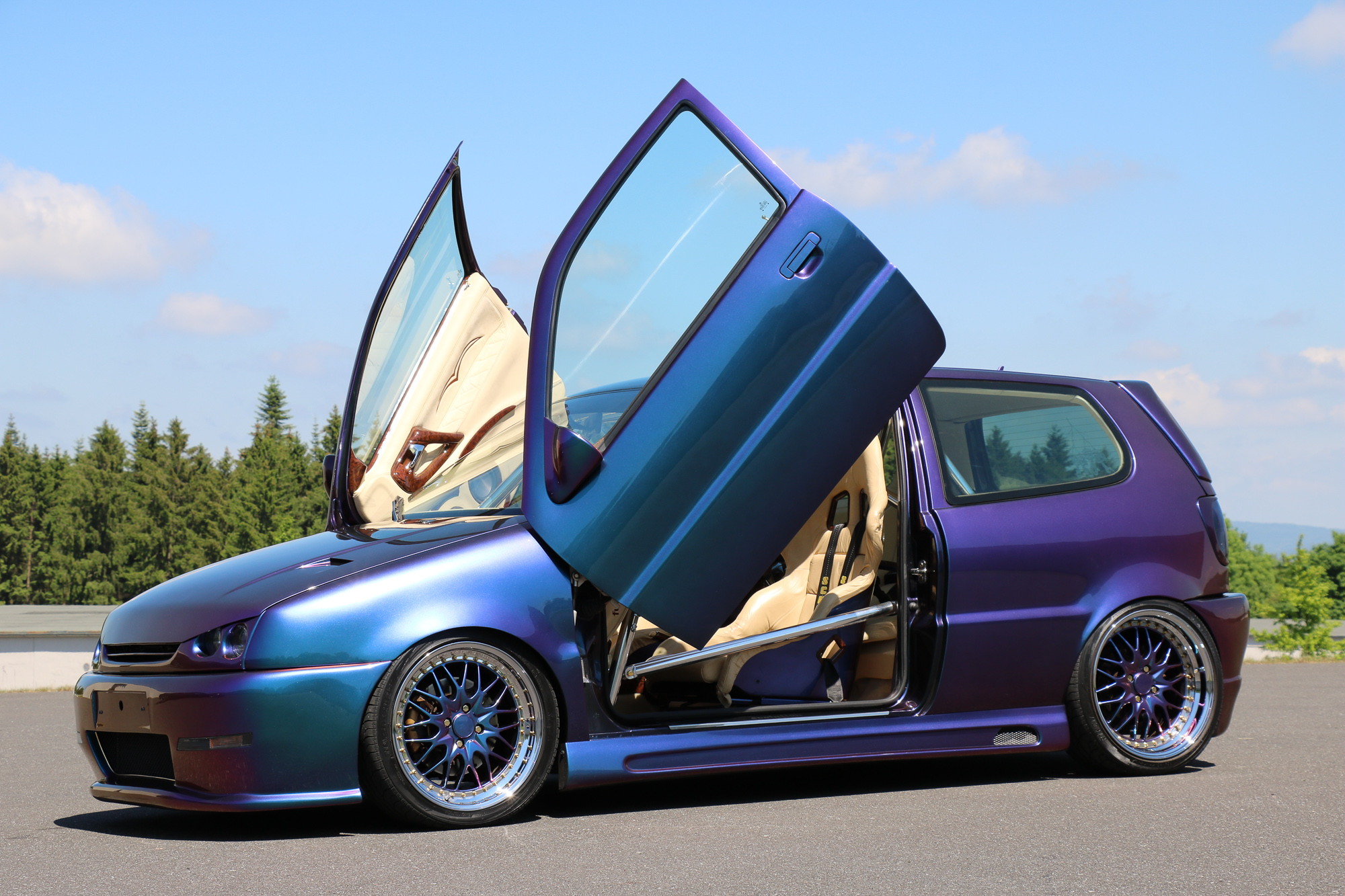
- VIP style: A Japanese style of customizing luxury cars that evolved from Bōsōzoku.A stanced MK3 Volkswagen Polo with aftermarket air suspension, light blue paint and BBS RM wheels with negative camber.
- Stanced: – This style is mostly associated with sports and passenger cars with lowered suspension setups. Custom wheels with low-profile tires play a large role in this style and often feature aggressive sizes, offsets, and camber.
- Cal look: A modified classic Volkswagen intended to evoke California through the use of bright colours, trim, and accessories.
- Military/service style: Cars designed to look like certain service vehicles.
- Hot rod: Style largely consisting of period-specific vehicles, components, and finishes to reproduce characteristics of early drag cars from the 1930s and 1940s.
- Custom car: Cars built primarily to show off.
- Sleeper: Stock-looking cars with performance upgrades.A Nissan 350Z modified for drifting.
- Rally car: Cars built to compete in rallies.
- Drift car: Cars engineered for drifting.
- Drag car: Cars modified for straight-line speed and acceleration.
- South London look: Subtly modified 50's-70's British Fords that are lowered, with pastel paint and 13 inch Lotus Cortina steel wheels or RS, Minilite, or Revolution mag wheels. These cars often use a tuned Ford Kent or Pinto engine.
- German look: A Volkswagen Type 1, Type 3, or Karmann Ghia lowered and fitted with late model Porsche mag wheels and touring car-influenced styling. Heavily modified suspension and drivetrain with emphasis on handling and cornering.
Tuning An 06 Auto For Sale
Glossary[edit]
- 30 roll
- A two-car straight-line race, often between tuned cars, starting from a steady 30 mph speed where the two drivers stand side-by-side, before one of them signals the rolling start by honking 3 times. The acceleration test ends at a pre-defined speed, e.g. 60 mph or 80 mph.
- Backfire
- Combustion of fuel in the intake or exhaust system instead of the combustion chamber, resulting in a distinctive popping sound and occasional flames. For clarity, the term 'afterfire' is sometimes used to refer to ignition within the exhaust, with 'backfire' referring to intake fuel ignition.
- BOV (blow-off valve)
- A valve that releases pressure in turbocharged engines when the throttle is closed, to avoid damage to the intake system and improve reliability. A BOV can vent either to the intake system prior to the turbocharger (this type of BOV is essentially silent and known as 'recirculating'). Other BOVs vent to the atmosphere, resulting in an easily identifiable hissing sound upon release of the throttle.
- CAI (cold air intake)
- A modified replacement intake system, often bypassing the stock airbox, meant to supply the engine with cold air from outside of the car (as opposed to hot air from under the bonnet). On most modern cars, the stock inlet ducts have been developed for peak performance and efficiency using advanced flow simulations, making aftermarket intake performance gain negligible. CAIs are instead mostly associated with their increased induction noise; coupled with an atmosphere-venting BOV on turbocharged cars and a non-resonated and sometimes 'decat' exhaust, such a setup is preferred by owners interested primarily in increasing the noise level of their cars, resulting in modifications with little to no performance benefit.
- Catback
- The portion of the exhaust system downstream from the catalytic converter.
- Custom tune
- A tune that has been customized for a particular car, often modified in specific ways that require adjustments to the stock calibration.
- Decat
- A straight exhaust pipe without a catalytic converter. On some vehicles, decat pipes allow flames to be visible at the exhaust tips upon throttle closure.
- Dig
- A race beginning from a standing start, e.g. from a traffic light.
- Dyno
- Slang for dynamometer.
- E-tuner
- A tuner working remotely to provide custom tunes over the internet, usually after the customer sends data logs of performance tests in the form of pulls (see below).
- FENG (fake engine noise generator)
- Often called a 'syntonizer', a system, either acoustic or electronic, that diffuses engine noise into the cockpit to enhance the driving experience. On some cars, like the 2015-18 Ford Focus RS, the noise is synthesized by a computer and bears no real relation to the noise generated by the engine. On other cars, the noise is conveyed by an acoustic pipe from the engine bay to the cockpit.
- FMIC (front-mounted intercooler)
- The term comes from the Subaru Impreza, which has its intercooler mounted in an unusual location just behind its engine. Beyond a certain threshold of power-increasing modifications, the small and ill-placed intercooler becomes ineffective, and a popular modification to overcome this limitation is to install an aftermarket intercooler in the conventional position behind the front bumper, giving rise to the term FMIC.
- Forging
- Replacing some of the engine's bottom-end internal elements with forged ones. The most common forged parts include connecting rods and pistons. Stage 3 cars can sometimes include a forged crankshaft. Forged parts are usually lighter and stronger than stock cast parts.
- Fully bolted
- Used to describe a car which has the maximum range of bolted-on engine upgrades without extensive modifications. These include aftermarket intakes, intercoolers, exhaust pipes, and mufflers.
- Hub dyno
- A chassis dynamometer with brakes that are connected directly to the driven wheel hubs after the wheels have been removed. They are more accurate than rolling road dynos, as they eliminate one significant source of slippage—the tires. Hub dynos are also more compact, the hub brakes being the size of small washing machines.
- Log
- A recording of the car or engine operating parameters (e.g. RPM, boost pressure, various temperatures) made when the car is being driven.
- Map
- A calibration for the engine management system, an electronic system known interchangeably as PCM (Powertrain Control System) or ECU (Engine Control Unit). A map is essentially a data file that gives the PCM the elements it needs to operate the engine according to the standards set by the manufacturer. The data is mostly organized in lookup tables known as 'maps', and the set of tables and other parameters is referred to as a 'map' or 'calibration'.
- Methanol injection
- A water injection system where a mixture of deionized water and a certain proportion of methanol is injected in the intake air stream as an anti-knock, usually using a dedicated pump and reservoir, and where the unmetered injection is triggered by a pressure switch activated once a certain boost level is reached on forced-induction engines. In some cases, the windscreen washer fluid reservoir is used as a tank for the water injection system (and still functions as usual). Water injection is believed to have appeared shortly before WWII on aero engines; notably, the Rolls-Royce Merlin and the Junkers Jumo 210 engines following the pre-WWII work of Sir Harry Ricardo. The methanol in the mixture injected in aero engines was present strictly as an anti-freeze, as it reduces the effectiveness of water as an anti-knock adjuvant.
- OTS (off-the-shelf) map
- A readily available tune sold with the accessory used to flash tunes to a car's engine control unit. OTS maps typically offer modest performance improvements and are often used as bases for further modifications.
- Pull
- A full-throttle RPM sweep in a straight line on a level road or a rolling road dynamometer, usually in 3rd or 4th gear and from low RPMs all the way to the engine rev limiter. Pulls are made to record logs or to measure engine output on a chassis dynamometer.
- Resonator
- A noise-reduction device that the exhaust pipe usually runs straight through, which dampens sound waves by the means of sound absorption material placed around a perforated tube section. Exhaust systems equipped with resonators are said to be 'resonated', as opposed to 'non-resonated' for those without such devices.
- Rolling road
- A chassis dynamometer which includes a metered brake that allows torque measurements, as well as speed measurements, which measure the torque and power produced at the wheels. Together with the inferred transmission ratio and a number of corrections related to atmospheric conditions and friction and losses, the software associated with the dyno can produce estimates of the flywheel power and torque figures.
- Stage 0
- The state of a car with no performance modifications.
- Stage 1
- The state of a car after simple modification, which can be just a tune, or a tune with simple supporting modifications such as an aftermarket air filter or intake. Stage 1 implies a modest power/torque increase over stock.
- Stage 2
- The state of a car after another round of modifications. Typically, stage 2 cars are fully bolted with a tune targeting higher torque and power, plus optional forging.
- Stage 3
- The state of a car with extensive mechanical modifications made to the powertrain, including (but not limited to) a bigger forced induction system, forged internals, retooling of cylinder heads, and fuel system modifications. Sometimes an aftermarket or motorsport ECU calibrated specifically for the car in question will be fitted. The power and torque outputs at this stage are significantly higher than stock, often prompting supporting modifications to the transmission and drivetrain.
- Stock map
- The OEM engine map.
- TMIC (top-mounted intercooler)
- An intercooler located above or just behind the engine, which benefits from a slight decrease in turbo lag but suffers from a maximum power threshold.
- Tune
- A modified map, most often aimed at increasing the engine torque and power output. A tune is 'flashed' to the PCM or ECU either by the tune vendor or the end-user itself, often using a stand-alone accessory connected to the car's OBDII connector or through a portable computer. A tune typically voids the powertrain warranty unless sanctioned by the car manufacturer (which is a rare occurrence). Typical changes include ignition timing, fuel flow, wastegate control for turbo engines, and modified limits such as those for RPM and boost.
- Tuner
- An individual or company creating tunes, usually for profit, and often selling supporting elements such as intakes and exhausts.
- Turboback
- The entire exhaust system downstream from the turbocharger turbine, composed of the downpipe (including the catalytic converter) and the catback portion.
- Turbo lag
- The delay between the initial throttle opening and the moment the turbocharger has spooled up sufficiently to deliver significant boost pressure and the associated torque and power increase. On stock modern turbos, lag is usually below one second, while some large aftermarket turbos exhibit lags of two seconds or more.
Legal requirements[edit]
Many countries or municipalities have legal requirements which govern vehicle modifications. For example, all vehicles in Victoria, Australia, must conform to construction standards to ensure vehicle safety.[4] There are also restrictions for P Plate drivers which can prevent young drivers from driving modified vehicles.[5]
Many developed countries have smog regulations, which generally forbid any modifications to engines or related components unless the modifications themselves are certified, like production car models. Such modifications, even if they do not actually result in increased emissions, prevent legal use on public roads.[6]
Sanctioning organizations[edit]
Many organizations involved in competitive motorsports establish safety guidelines that far exceed legal requirements placed on street-legal vehicles. The NHRA, IHRA and SOLO all require that vehicles pass inspection to ensure that all regulations are being complied with.
See also[edit]
Tuning An 06 Automatic
References[edit]
Tuning An 06 Auto Parts
| Wikimedia Commons has media related to Customized vehicles. |
- ^ abChang, Richard (Summer 2008), 'Access Denied', 0-60 Magazine
- ^LeftlaneNews R32, R34 Nissan Skyline imports halted
- ^LASD Inmate Information Center - Booking DetailsArchived December 16, 2009, at the Wayback Machine
- ^Vehicle Standards Information BulletinsArchived September 13, 2007, at the Wayback Machine
- ^High Powered Vehicle RestrictionsArchived September 14, 2007, at the Wayback Machine
- ^an old issue of Hotrod Magazine