Little Snitch Incoming Connection Denied Google Helper
- Little Snitch Incoming Connection Denied Google Helper Download
- Little Snitch Incoming Connection Denied Google Helper Account
- Little Snitch Incoming Connection Denied Google Helper Email
- Little Snitch Incoming Connection Denied Google Helper Login
This release contains changes in the following areas:
Mar 30, 2020 Little Snitch warns about potential consequences when you deny a connection and Little Snitch knows the purpose of the connection. Since this warning may be annoying, it can now be disabled on a per-application basis. Added support for additional remote endpoint types in the Internet Access Policy. The IAP can now contain information about Berkeley Packet Filter access and connections to. Should I block incoming connections from “netbiosd”? (application) firewall settings are configured to block incoming connections from netbiosd. I don't recall setting this myself, and wonder what the consequences are. @MottiShneor This is where a preogram Little Snitch helps it asks for each outbound connection to be allowed. Aug 10, 2018 Little Snitch 4.1.3 Crack + License Key Free Download. Little Snitch 4.1.3 Crack is the ideal program that protects you from questionable unwanted net connections. It’s the very best network monitoring tool which appears after your incoming and outgoing data link. Jul 28, 2015 Hello. I recently purchased Little Snitch, and i'm incredibly happy with the product, but still i have a little 'problem'. When browsing Google Chrome (on trusty sites) for every site i try to contact little snitch asks for the permission to allow connections about 5,6 times for different ips (for each site), making the browsing experience really uncomfortable. Little Snitch is a firewall application that monitors and controls outbound internet traffic. If you're looking for more info about Little Snitch like screenshots, reviews and comments you should visit our info page about it. Below you find the best alternatives. The.lsrules file format. Rule group subscriptions use a.lsrules file, which is a JSON format specified in this chapter. Such files can be exported using Little Snitch Configuration or created using a text editor or a script. A simple example. Let’s start with a simple example that specifies a single rule for allowing software updates for LaunchBar.
Improved detection of program modification
Little Snitch has a security mechanism that ensures rules are only applied to programs for which they were originally created. This is to prevent malware from hijacking existing rules for legitimate programs. To do that, Little Snitch must be able to detect whether a program was modified. How Little Snitch does that changes with this version.
Previous versions required a program to have a valid code signature in order to be able to detect illegitimate modifications later on. Programs without a code signature could not be validated and Little Snitch warned accordingly. The focus was therefore on a program’s code signature.
Beginning with version 4.3, Little Snitch can always check whether a program has been tampered with, even if it’s not code signed at all. The focus is now on checking for modifications with the best means available. That is usually still the code signature but for programs that are not code signed, Little Snitch now computes a secure hash over the program’s executable. (There’s still a warning if a process is not signed, but only to inform you about a possible anomaly.)
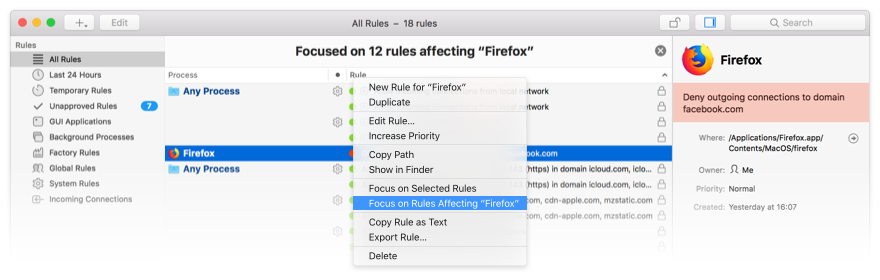
This change leads to a different terminology. When editing a rule, Little Snitch Configuration no longer shows a checkbox titled “requires valid code signature” but instead one that is titled “check process identity” (or if the rule is for any process: “apply to trusted processes only”).
Instead of a “code signature mismatch”, Little Snitch’s connection alert now informs that “the program has been modified”.
In cases where Little Snitch detects such a modification, it now also better explains the possible underlying cause and the potential consequences.
For more information see the chapter Code identity checks in the online help.
Configuration File Compatibility
This version uses a new format with speed and size improvements for the configuration file in which the current rule set and the preferences are stored. This new file format is not compatible with older versions of Little Snitch, though.When updating to Little Snitch 4.3, the old configuration file is left untouched in case you want to downgrade to a previous version of Little Snitch. All changes made in Little Snitch 4.3 or later are not included in the old file, of course.Note that backup files created using File > Create Backup… in Little Snitch Configuration use the old file format and are therefore backward-compatible with previous versions of Little Snitch.
Year / Release Date: 6/12/2019Version: 9.1.0Developer: AntaresDeveloper’s site: AntaresFormat: VST / VST3 / AAXBit: 64bitTabletka: curedSystem Requirements: Windows 8.1 to Windows 10 as requiredDescription: Auto-Tune Pro is the most complete and advanced version of Auto-Tune. 
Improved Support for macOS Mojave
- Improved appearance in Dark Mode.
- Fixed backup restore from Time Machine not working in Little Snitch Configuration due to the new “Full Disk Access” security mechanism.
- Fixed creating Diagnostics Reports for non-admin users (on macOS High Sierra and later). When you contact our tech support, we sometimes ask you to create these reports.
Performance Improvements
- Improved overall performance for large rule sets.
- Reduced CPU load of Little Snitch Daemon during DNS lookups.
- Reduced CPU load of Network Monitor while inactive.
- Improved performance of rule sorting in Little Snitch Configuration, which leads to better overall performance.
- Fixed Little Snitch Daemon hanging while updating a rule group subscription that contains many rules.
- Fixed a memory leak that occurred when closing a snapshot window in Network Monitor.
Internet Access Policy
- Fixed an issue causing an app’s Internet Access Policy not being shown if that app was running in App Translocation.
- Fixed clickable links not working in the “Deny Consequences” popover when creating rules in connection alert or Network Monitor.
- Internet Access Policy file: Fixed large values for a connection’s “Port” being rejected.
Process Identity and Code Signature Check Improvements
- Added support for detecting revoked code signing certificates when checking a process’ code signature. The connection alert and Network Monitor now treat such processes like processes without a valid code signature and show relevant information. Also, rules created will use an appropriate identity check (based on the executable’s checksum, not based on the code signature).
- When showing a connection alert for a process that has no valid code signature, Little Snitch now tries to find out if loading a shared library may have caused the issue with the code signature. If so, this is pointed out in the connection alert.
- Fixed handling of app updates while the app is still running: Previous versions of Little Snitch would complain that the code signature could not be checked if the running app was replaced on disk, e.g. during an update.
- Fixed an issue where connection alerts would erroneously contain a warning that an application’s code signing certificate was unacceptable. This mainly happened when a process’ first connection was an incoming connection.
Improved Handling of Connection Denials and Override Rules
- Improved handling of override deny-rules that were created as a consequence of a suspicious program modification (“Connection Denials”). In Network Monitor, these rules are now marked with a dedicated symbol. Clicking that symbol allows to remove that override rule, if the modification is confirmed to be legitimate.
- Changed override deny-rules created for failed code identity checks to not be editable or deletable. Instead, double-clicking such a rule allows you to fix the underlying issue, which then automatically deletes the override rule.
UI and UX Improvements
- Automatically combine rules: For improved handling of large rule sets with many similar rules that only differ in host or domain names. This is common when subscribing to blocklists, which may contain thousands of similar, individual rules denying connections to various servers. The new “Automatically combine rules” option in Little Snitch Configuration (on by default) now combines such similar rules into a single row, making it much easier to keep track of large lists of rules.
- Improved appearance when Accessibility option 'Increase contrast' is active.
- Improved floating window mode in Network Monitor.
- When choosing File > Restore from Backup in Little Snitch Configuration, the list showing possible backup files now includes backups that Little Snitch created automatically.
- Improved the map shown in the “Known Networks” window in Little Snitch Configuration.
- Improved the legibility of traffic rates in the status menu on Retina displays.
- Fixed data rates shown in Network Monitor to match the values shown in the status menu.
- Fixed the “Duration” setting in Preferences > Alert > Preselected Options not being respected.
- Fixed an issue with “undo” when unsubscribing from a rule group or when deleting a profile.
- Fixed an issue in Little Snitch Configuration where the “Turn into global rule” action did not work.
- Fixed an issue where an error that occurred in the course of a previous rule group subscription update was still displayed, even though the problem no longer existed.
Other Improvements and Bug Fixes
Little Snitch Incoming Connection Denied Google Helper Download
- Increased the maximum number of host names allowed in a rule group subscription to 200.000.
- Fixed an issue causing XPC services inside bundled frameworks to not be recognized as XPC. This resulted in connection alerts to be shown for the XPC services themselves instead of for the app the service belongs to.
- Fixed an issue causing Time Machine backups to Samba servers to stop working under some circumstances.
- Fixed an issue related to VPN connections with Split DNS configuration that caused only the server’s IP address to be displayed instead of its hostname.
- Reduced the snap length in PCAP files, allowing them to be analyzed not only with Wireshark but also with “tcpdump”.
This release contains changes in the following areas:
Improved detection of program modification
Little Snitch has a security mechanism that ensures rules are only applied to programs for which they were originally created. This is to prevent malware from hijacking existing rules for legitimate programs. To do that, Little Snitch must be able to detect whether a program was modified. How Little Snitch does that changes with this version.
Little Snitch Incoming Connection Denied Google Helper Account
Previous versions required a program to have a valid code signature in order to be able to detect illegitimate modifications later on. Programs without a code signature could not be validated and Little Snitch warned accordingly. The focus was therefore on a program’s code signature.
Beginning with version 4.3, Little Snitch can always check whether a program has been tampered with, even if it’s not code signed at all. The focus is now on checking for modifications with the best means available. That is usually still the code signature but for programs that are not code signed, Little Snitch now computes a secure hash over the program’s executable. (There’s still a warning if a process is not signed, but only to inform you about a possible anomaly.)
This change leads to a different terminology. When editing a rule, Little Snitch Configuration no longer shows a checkbox titled “requires valid code signature” but instead one that is titled “check process identity” (or if the rule is for any process: “apply to trusted processes only”).
Instead of a “code signature mismatch”, Little Snitch’s connection alert now informs that “the program has been modified”.
In cases where Little Snitch detects such a modification, it now also better explains the possible underlying cause and the potential consequences.
For more information see the chapter Code identity checks in the online help.
104 rows Dev-C A free, portable, fast and simple C/C IDE. Download Latest Version Dev. May 08, 2015 Dev-C Portable on 32-bit and 64-bit PCs This download is licensed as freeware for the Windows (32-bit and 64-bit) operating system on a laptop or desktop PC from programming software without restrictions. Dev-C Portable 5.11 Free Download. Clicking the below button will start downloader the standalone portable version of Dev-C Portable 5.11 for Windows. It is compatible with x86 and x64 architecture. It is a free and powerful IDE for developing C/C projects. Dev c++ portable free download windows 7. Nov 29, 2016 Download Dev-C for free. A free, portable, fast and simple C/C IDE. A new and improved fork of Bloodshed Dev-C. Join/Login; Open Source Software; Business Software. Enterprise is a universal rapid application development platform for build business management solutions in HORECA, Retail, Manufacture, Logistic, Finance and other. Apr 28, 2015 Dev-C Portable is the on-the-go version of Dev-C.It has all the features that come with Dev-C, but the difference is that you can directly run it from an external device, without having to.
Configuration File Compatibility
This version uses a new format with speed and size improvements for the configuration file in which the current rule set and the preferences are stored. This new file format is not compatible with older versions of Little Snitch, though.When updating to Little Snitch 4.3, the old configuration file is left untouched in case you want to downgrade to a previous version of Little Snitch. All changes made in Little Snitch 4.3 or later are not included in the old file, of course.Note that backup files created using File > Create Backup… in Little Snitch Configuration use the old file format and are therefore backward-compatible with previous versions of Little Snitch.
Improved Support for macOS Mojave
- Improved appearance in Dark Mode.
- Fixed backup restore from Time Machine not working in Little Snitch Configuration due to the new “Full Disk Access” security mechanism.
- Fixed creating Diagnostics Reports for non-admin users (on macOS High Sierra and later). When you contact our tech support, we sometimes ask you to create these reports.
Little Snitch Incoming Connection Denied Google Helper Email
Performance Improvements
- Improved overall performance for large rule sets.
- Reduced CPU load of Little Snitch Daemon during DNS lookups.
- Reduced CPU load of Network Monitor while inactive.
- Improved performance of rule sorting in Little Snitch Configuration, which leads to better overall performance.
- Fixed Little Snitch Daemon hanging while updating a rule group subscription that contains many rules.
- Fixed a memory leak that occurred when closing a snapshot window in Network Monitor.
Little Snitch Incoming Connection Denied Google Helper Login
Internet Access Policy
- Fixed an issue causing an app’s Internet Access Policy not being shown if that app was running in App Translocation.
- Fixed clickable links not working in the “Deny Consequences” popover when creating rules in connection alert or Network Monitor.
- Internet Access Policy file: Fixed large values for a connection’s “Port” being rejected.
Process Identity and Code Signature Check Improvements
- Added support for detecting revoked code signing certificates when checking a process’ code signature. The connection alert and Network Monitor now treat such processes like processes without a valid code signature and show relevant information. Also, rules created will use an appropriate identity check (based on the executable’s checksum, not based on the code signature).
- When showing a connection alert for a process that has no valid code signature, Little Snitch now tries to find out if loading a shared library may have caused the issue with the code signature. If so, this is pointed out in the connection alert.
- Fixed handling of app updates while the app is still running: Previous versions of Little Snitch would complain that the code signature could not be checked if the running app was replaced on disk, e.g. during an update.
- Fixed an issue where connection alerts would erroneously contain a warning that an application’s code signing certificate was unacceptable. This mainly happened when a process’ first connection was an incoming connection.
Improved Handling of Connection Denials and Override Rules
- Improved handling of override deny-rules that were created as a consequence of a suspicious program modification (“Connection Denials”). In Network Monitor, these rules are now marked with a dedicated symbol. Clicking that symbol allows to remove that override rule, if the modification is confirmed to be legitimate.
- Changed override deny-rules created for failed code identity checks to not be editable or deletable. Instead, double-clicking such a rule allows you to fix the underlying issue, which then automatically deletes the override rule.
UI and UX Improvements
- Automatically combine rules: For improved handling of large rule sets with many similar rules that only differ in host or domain names. This is common when subscribing to blocklists, which may contain thousands of similar, individual rules denying connections to various servers. The new “Automatically combine rules” option in Little Snitch Configuration (on by default) now combines such similar rules into a single row, making it much easier to keep track of large lists of rules.
- Improved appearance when Accessibility option 'Increase contrast' is active.
- Improved floating window mode in Network Monitor.
- When choosing File > Restore from Backup in Little Snitch Configuration, the list showing possible backup files now includes backups that Little Snitch created automatically.
- Improved the map shown in the “Known Networks” window in Little Snitch Configuration.
- Improved the legibility of traffic rates in the status menu on Retina displays.
- Fixed data rates shown in Network Monitor to match the values shown in the status menu.
- Fixed the “Duration” setting in Preferences > Alert > Preselected Options not being respected.
- Fixed an issue with “undo” when unsubscribing from a rule group or when deleting a profile.
- Fixed an issue in Little Snitch Configuration where the “Turn into global rule” action did not work.
- Fixed an issue where an error that occurred in the course of a previous rule group subscription update was still displayed, even though the problem no longer existed.
Other Improvements and Bug Fixes
- Increased the maximum number of host names allowed in a rule group subscription to 200.000.
- Fixed an issue causing XPC services inside bundled frameworks to not be recognized as XPC. This resulted in connection alerts to be shown for the XPC services themselves instead of for the app the service belongs to.
- Fixed an issue causing Time Machine backups to Samba servers to stop working under some circumstances.
- Fixed an issue related to VPN connections with Split DNS configuration that caused only the server’s IP address to be displayed instead of its hostname.
- Reduced the snap length in PCAP files, allowing them to be analyzed not only with Wireshark but also with “tcpdump”.